MAKING HISTORY
Press Release
Venice, Italy – Michelle Jung is pleased to announce the debut of a new four-panel painting, Four Corners of the World (2026), on the occasion of Personal Structures – Confluences, the biennial contemporary art exhibition, opening this spring and organized by the European Cultural Centre Italy, running parallel to La Biennale di Venezia. The 8th edition of Personal Structures will explore the intersections of individuals, communities, and their environments, illuminating collective experiences through intimate personal narratives on Venice’s biennial global stage. Past invitees include Yoko Ono, Joseph Kosuth, Roman Opalka, Hermann Nitsch, Martin Parr, Xu Bing, Marina Abramovic, Arnulf Rainer, Nobuyoshi Araki, Lee Ufan, Miles Greenberg, and Emily Young, among others.
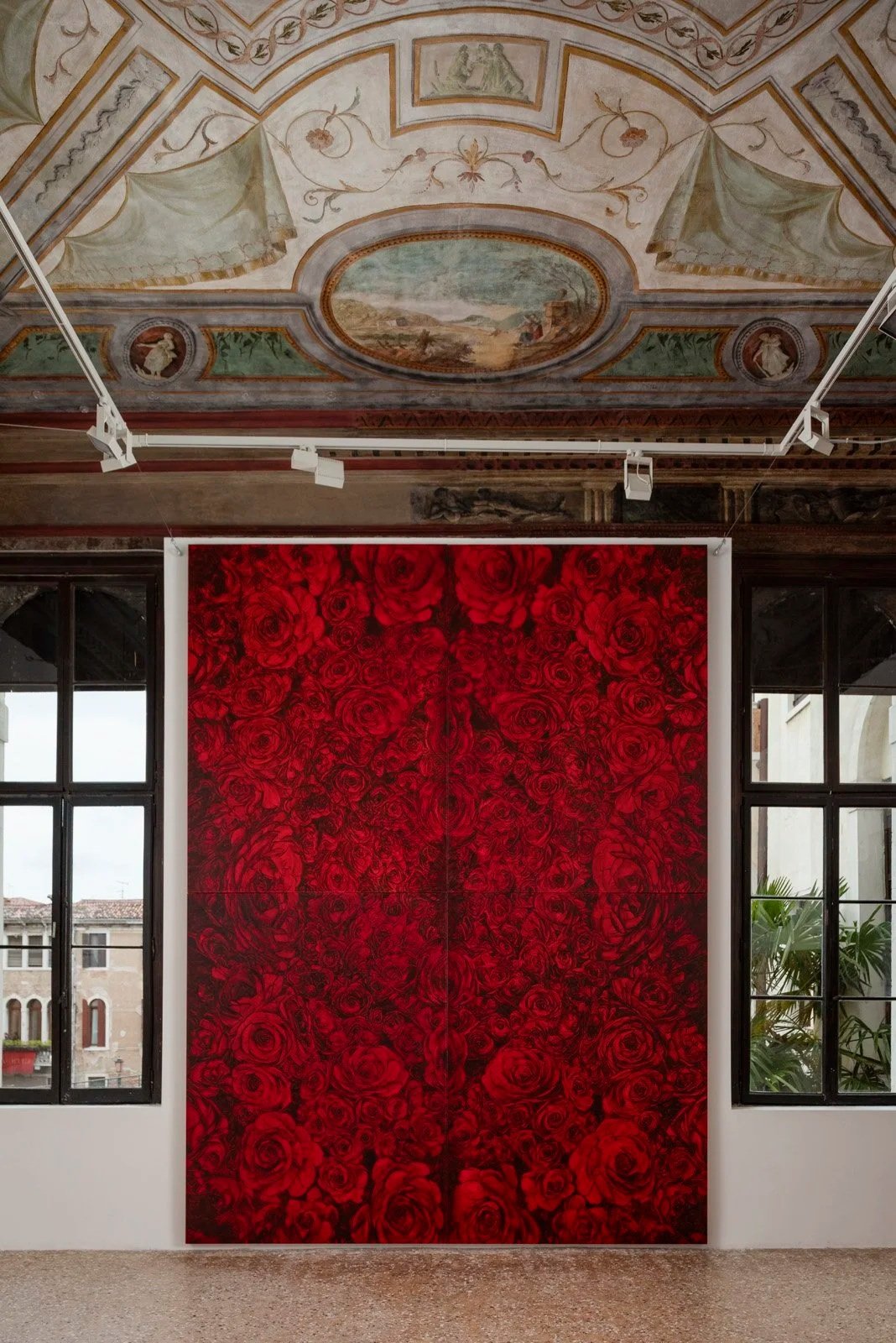
Four Corners of the World unites layered histories and geographies of painting, design, and composition—traditions that derive from European Old Masters, contemporary web creators, and twentieth-century color field painters such as Barnett Newman and Mark Rothko. Composed in four canvas panels that combine to form an 15 by 11-foot expanse, Four Corners of the World is Jung’s largest work to date—and its dense, hand-painted composition is no less monumental in scope. Jung combines Renaissance painting techniques like chiaroscuro and traditional glazing with the stylings of mid-twentieth-century modernists, layering centuries of art-historical tradition within a deceptively simple composition.
A dense mass of red, plantlike forms fills the quadriptych, their creases and folds emerging above the background. At first glance, the large landscape immerses the viewer in a natural world, as though one were lying face down in a lush bed of roses. In each floral design, ruby-red petals unfurl around a narrow center, like tulips or rhododendrons that have only recently bloomed. Upon investigation, however, these plants are revealed to be not flowers at all but succulents. Their petals are waxy, fleshy leaves that thin into sharp corners, their blossoming, circular shape resembling that of an aloe or echeveria plant. This mixture of environments is no accident: Jung began developing and painting Four Corners of the World as her gardening practice adapted to an increasingly drought-prone climate (the composition includes a succulent from her garden). The painting represents an illusory middle ground between the two habitats, a vivid floral environment that rewards long, intent viewing.
The colors of the painting adopt their uniquely three-dimensional appearance not from nature, but from the shades, textures, and techniques of contemporary digital life. Visible through Jung’s floral, tapestry-like composition is an underpainting that derives its singular tone from colors found in web design and technology. Their inclusion infuses the natural forms of Jung’s artwork with the uncanny, subtly inflecting their organic structure with the hues of the present day. A red “filter” of transparent paint applied to the artwork’s surface lends each succulent its ruby appearance, much like image-editing software might transform a banal landscape into a vivid, unreal scene. Its surreal quality is amplified by the canvas’s response to light: Jung’s layered, translucent lacquers transform the succulents in her composition into a three-dimensional field—an effect that recalls the iridescent glow of a television or computer screen.
Flowers have been an enduring artistic subject for millennia. Jung’s composition initially evokes such associations, only to reveal these assumptions as incorrect. While global temperatures rise and the consequences of climate change become imminent, the drought-tolerant succulents of the Four Corners of the World offer an environmentalist vision: her painting’s composition, like her garden, has adapted to a drier habitat—just as many others, facing worldwide drought, inevitably must. The artwork’s awe-inspiring, sublime scene is both challenging and resilient, an emphatic call for the “four corners” of our world to unite in the face of natural threat.
Michelle Jung’s Four Corners of the World artwork will be on view at Palazzo Mora from May 9th to November 22nd, 2026.